
Sunscreen for golf should be broad spectrum, SPF 30 or higher (the American Academy of Dermatology's minimum) and labeled Water Resistant (80 minutes), and it goes on 15 minutes before you head out to the range or the first tee. During the round, reapply after 80 minutes of sweating, immediately after you towel off, and at least every 2 hours, whichever comes first: the three reapply lines the FDA's sunscreen rule, 21 CFR 201.327, requires on an 80-minute label. The SPF 30 floor and water resistance are the Academy's recommendations, the 80-minute rating is the longer of the two the rule allows, and the timings are the label's.
A round is one long block outdoors, often in the window the FDA describes as "between the hours of 10 a.m. and 2 p.m., when the sun's rays are most intense." The Skin Cancer Foundation says the same of golf: "A round can mean prolonged sun exposure, often during the sunniest hours of the day." And when you wipe sweat off your face or arms with the towel on your bag, the label counts that as a reapply trigger: "immediately after towel drying."
This page covers choosing and using sunscreen for golf by what US labels say: the label words, water resistance, putting it on, reapplying from the first tee to the 18th green, missed spots, tee times, winter rounds, the bag and what to wear. It does not rank products. The general reapply schedule and amounts live in the linked guides, and the directions on your own sunscreen govern.
What is the best sunscreen for golf?
The best sunscreen for golf is one whose label says Broad Spectrum, SPF 30 or higher (the American Academy of Dermatology's floor) and Water Resistant (80 minutes), in a format you will actually reapply. We do not rank products here.
| What to look for | What it means | Source |
|---|---|---|
| Broad Spectrum | Protects against UVA and UVB rays. On the front it reads “Broad Spectrum SPF” and the number. | AAD Sunscreen FAQs; 201.327(a)(1) |
| SPF 30 or higher | SPF, the sun protection factor, is the number on the front. The American Academy of Dermatology’s minimum is 30. | AAD Sunscreen FAQs; AAD Understand sunscreen labels; 201.327(a)(1) |
| Water Resistant (40 minutes) or (80 minutes) | The only two water-resistance statements the rule allows on the front. The AAD recommends water resistance; for a round, this page picks 80 minutes. | 201.327(a)(2); AAD Sunscreen FAQs |
| A format you will reapply | “The best type of sunscreen is the one you will use again and again.” | AAD Sunscreen FAQs |
The FDA's rule defines no "golf sunscreen" and no "sport" category; what a sport label can say is in sport sunscreen vs regular sunscreen.
Why do golfers need sunscreen?
Golfers need sunscreen because a round keeps your skin in daylight for hours. Here is what four studies of golfers say:
- United States, 2021. Penn State researchers ran a web survey of 347 adult golfers recruited across the US. Their summary sets out why golfers were studied: "Golf is a popular sport that increases UV exposure because it is played outdoors in daylight" (PubMed 34299704).
- Queensland, Australia, 2009. Researchers measured the UV reaching golfers' forearms, upper backs and the tops of their heads from summer into winter. Average summer exposures were 1.4, 2.2 and 3.2 standard erythema doses (a unit of sunburning UV), so the top of the head took more than twice the forearm's dose (PubMed 19906167).
- Australia, 2023. A self-reported survey of 336 golf participants, set against 15,780 people in a national health survey: 27% of the golfers reported a skin cancer diagnosis, against 7% of the general sample, and adjusted for age, sex, education and smoking they were 2.42 times as likely to report one. That is an association, not proof that golf caused it (PubMed 37485003).
- Costa del Sol, Spain, 2015. A cross-sectional skin-check campaign at six golf courses diagnosed skin cancer in 10.7% of the golfers examined (PubMed 25172442).
A US label's Uses line says what sunscreen is for: "Helps prevent sunburn," and, on a broad spectrum label of the kind described above, it may add: "If used as directed with other sun protection measures (see Directions), decreases the risk of skin cancer and early skin aging caused by the sun" (201.327(c)(1) and (c)(2)). The other measures (a hat, sunglasses, clothing and shade) are covered further down.
Do you need water-resistant sunscreen for golf?
Yes: the AAD recommends water resistance for everyone, a round brings sweat and towels, and the longer of the two ratings a US label may carry is Water Resistant (80 minutes). The FDA says water-resistance claims, "for 40 or 80 minutes, tell you how much time you can expect to get the labeled SPF-level of protection while swimming or sweating."
The FDA puts it plainly: "Manufacturers may not make claims that their sunscreens are 'waterproof' or 'sweat proof.'" The rule lists those words among the claims that would make a sunscreen label false or misleading:
There are claims that would be false and/or misleading on sunscreen products. These claims include but are not limited to the following: “Sunblock,” “sweatproof,” and “waterproof.” These or similar claims will cause the product to be misbranded under section 502 of the FD&C Act (21 U.S.C. 352).
U.S. Government Publishing Office · read word for word on This paragraph names three words a US sunscreen label may not use, and says similar claims are treated the same way.
Water resistance does not replace the 2-hour line. The AAD's label guide: "Even if your skin remains dry while using a water-resistant sunscreen, you'll need to reapply the sunscreen every 2 hours." The claim rests on a standard water test set out in 201.327(i)(7); how it works is in the 40- and 80-minute test.
How do you put on sunscreen before a round of golf?
Put it on 15 minutes before you head out, before the glove goes on and before you take a club out of the bag.
- Fifteen minutes ahead: at home, in the parking lot or in the locker room. Labels say to apply 15 minutes before sun exposure (201.327(e)(1)(ii)), and the FDA's own direction is the same: "Apply 15 minutes before sun exposure."
- Use the amount the label asks for. The label's word is "liberally" (some labels say "generously"), and the AAD notes that many people apply only 20 to 50 percent of the amount needed to reach the SPF on the label. The AAD's figures are in how much sunscreen should you use.
- Do the backs of both hands, then wipe your palms on a towel before you take a club out. The backs of the hands face the sun ("Hands" are on the FDA's list of frequently forgotten spots); the palms hold the club.
- Let it dry before the cap and glove go on (and before the polo, if you apply at home or in the locker room); see keeping sunscreen off your clothes.
- Wait out the rest of the 15 minutes, then head to the range or the first tee.
The rule also requires this warning on every sunscreen label: "keep out of eyes. Rinse with water to remove" (201.327(d)(1)(ii)); see why sunscreen stings.
When should you reapply sunscreen during a round of golf?
Reapply after 80 minutes of sweating, immediately after any towel wipe, and at least every 2 hours, whichever comes first.
| Moment in the round | What to do | Where it comes from |
|---|---|---|
| Before you head out | Apply 15 minutes ahead | Label: “Apply liberally 15 minutes before sun exposure” |
| Any towel wipe across the face, neck or forearms: the bag towel, or drying off after rain | Reapply right away | Label: “immediately after towel drying”; the CDC: “toweling off” |
| A hot round where you sweat throughout | Set a phone or watch timer for 80 minutes from when you applied, and reapply when it sounds | Label: “after 80 minutes of swimming or sweating” |
| Two hours since you last applied, sweating or not | Reapply | Label: “at least every 2 hours” |
| The turn (the stop between the front nine and the back nine), or another hole you pick | A fixed stop to reapply every round, on top of the lines above, never instead of them | The Skin Cancer Foundation: “designate a hole or two where you will always reapply” (not a label line) |
If your round runs past two hours, the label says reapply: the rule counts minutes and towels, not holes. Two other kinds of label change the sweat line. A 40-minute label reads "after 40 minutes of swimming or sweating" (201.327(e)(3)). A label with no water-resistance claim reads "reapply at least every 2 hours" and "use a water resistant sunscreen if swimming or sweating" (201.327(e)(4)).
Away from the course, see reapplying after swimming or sweating and a reapply routine for a day outside.
Which spots do golfers miss with sunscreen?
The top of the head, the ears, the back of the neck, the lips and the backs of the hands: the places a cap and a glove leave half covered.
- The top of the head and the hairline, including the part line and the gap above a cap's back strap. The FDA: "If you don't have much hair, apply sunscreen to the top of your head or wear a hat." Of the three sites the Queensland study above measured, the top of the head took the most UV.
- Ears. On the FDA's list of frequently forgotten spots, and a cap's brim does not shade them.
- Back of the neck. On the FDA's list; it faces the sky every time you look down at the ball.
- Nose. On the FDA's list.
- Lips. The AAD's advice is a lip balm with an SPF of at least 30.
- Backs of the hands, especially the hand without a glove. "Hands" are on the FDA's list.
- Legs below your shorts. The AAD's list: "Remember your neck, face, ears, tops of your feet, and legs."
Both agencies' lists, side by side: the spots people miss.
When is UV strongest on a golf course?
Around midday, when your shadow is shorter than you are: the EPA's shadow rule says that is when you are exposed to higher levels of UV radiation.
The FDA's window is "between the hours of 10 a.m. and 2 p.m." The CDC's is wider: "In the continental United States, UV rays are strongest from 10 a.m. to 4 p.m. daylight saving time (9 a.m. to 3 p.m. standard time)."
Check the UV Index for the day of your round: a daily forecast on a "1 – 11+ scale," issued by the National Weather Service and EPA. From 3 to 7 the EPA's guidance is "Protection needed," and from 8 up it is "Extra protection needed." The WHO draws the same line at 3: "Sun protection measures should be used when the UVI reaches 3 or above."
Your tee time decides how much of the midday peak you play through. A 2011 modeling study of golfers' yearly UV exposure found that mid-morning tee times generally present the greatest risk (PubMed 21862342). A round that starts mid-morning is still going in the middle of the day. The Skin Cancer Foundation's advice is to "schedule your rounds very early in the morning or late in the afternoon when the sun is less intense."
Bunkers and water hazards add reflection. The EPA: "Water, snow and sand reflect the damaging rays of the sun, which can increase your chance of sunburn."

Do you need sunscreen for golf in winter or on a cloudy day?
Yes: golfers need sunscreen on cloudy days too, and the AAD's advice includes winter. The FDA: "Even on an overcast day, up to 80% of the sun's UV rays can get through the clouds." The AAD says your skin is exposed to UV every time you go outside, "even on cloudy days and in the winter."
The Queensland golfers' average winter exposures were 0.2, 0.3 and 0.5 standard erythema doses at the same three sites: lower than summer, not zero. A study of golfers playing in Valencia, Spain, in January reports that harmful effects "may occur not only in summer time but also in winter" (PubMed 24893676).
So check the day's UV Index forecast; in the FDA's words, "Sun safety is always in season." On a cool, dry round, the 2-hour line from the AAD's label guide still applies.
Lotion, stick or spray: what to keep in your golf bag
Any of the three works if the label carries the right words; keep it in the bag, out of direct sun.
| Format | What the AAD says | On the course |
|---|---|---|
| Lotion or cream: a tube, a bottle or a sealed single-use packet | Among the options it lists: “lotions, creams, gels, ointments, wax sticks, and sprays” | Rub it in by hand, then let it dry |
| Stick | “Sticks are easy for under the eyes and the backs of the hands” | The face and the ungloved hand |
| Spray | “Avoid using spray sunscreen on windy days,” and avoid inhaling it by “not spraying it into the wind” | Spray in the parking lot, never on a windy tee |
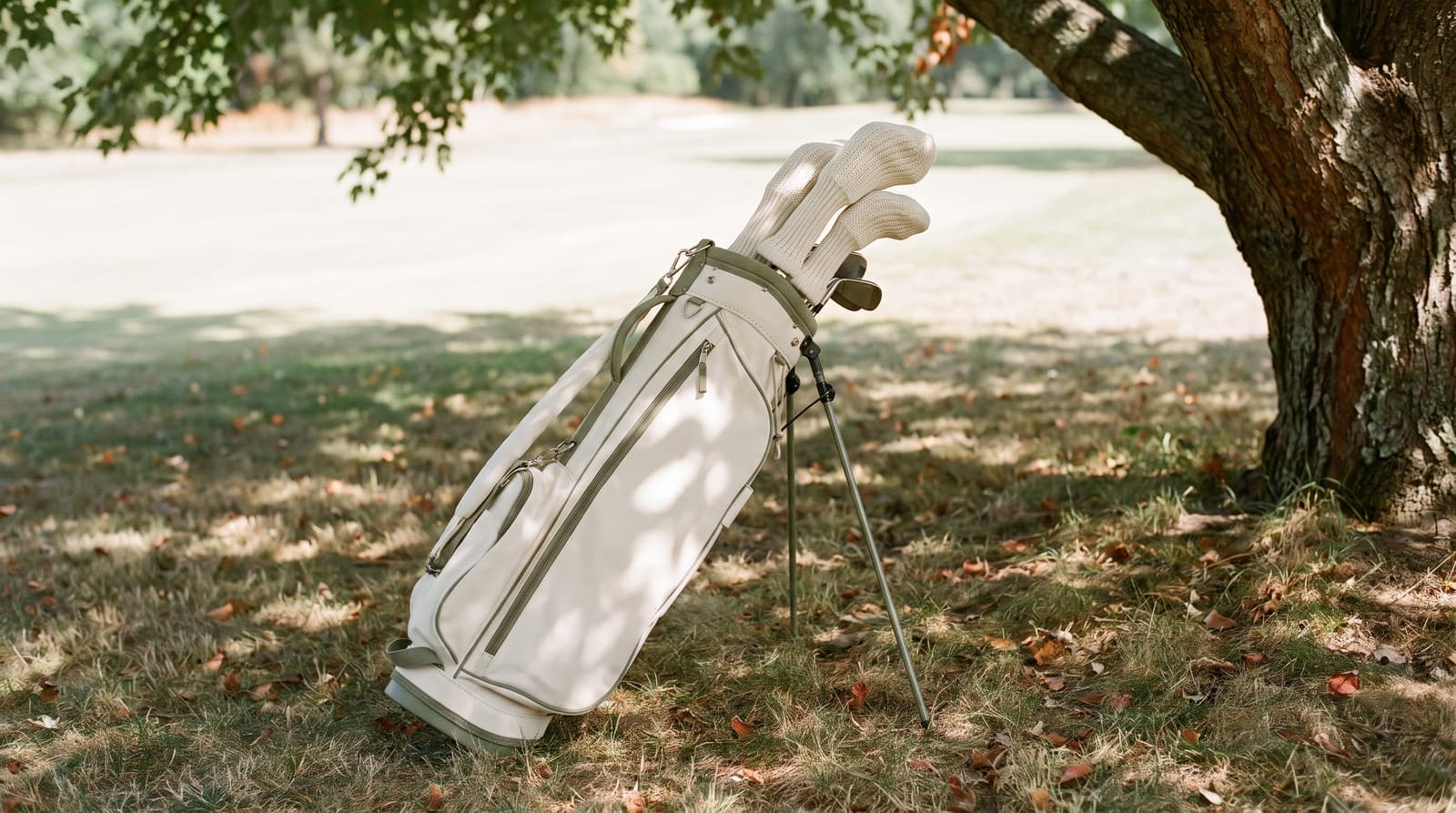
The FDA recommends keeping sunscreen containers out of direct sun, "wrapping the containers in towels or keeping them in the shade"; the AAD says not to leave them "inside of the car." So: a closed bag pocket, with the bag in the shade when you can, not the cart seat or the trunk.
Also in the bag: a lip balm with an SPF of 30 or higher (the AAD's floor for lips), a hat, sunglasses and the towel. A towel wipe across your face, neck or arms means a reapply.
What should golfers wear for sun protection?
Sunscreen is one layer; the FDA, AAD and CDC add a hat, sunglasses, covering clothing and shade.
- A hat with a wide brim. The AAD: choose "one that has a wide brim, which will protect your ears, as well as your head and neck." If you wear a baseball cap, the CDC's advice is to "wear clothing that covers your ears and the back of your neck, use sunscreen, or stay in the shade."
- Sunglasses with UV protection. The FDA: "Choose sunglasses with a UV400 rating or '100% UV protection' on the label." The AAD adds that "large-framed or wraparound sunglasses offer more sun protection than aviators."
- Covering clothing. The AAD: "a long-sleeved denim shirt provides an SPF of about 1,700, while a white t-shirt provides an SPF of about 7," and it says to "select clothing with an ultraviolet protection factor (UPF) number on the label."
- Shade between shots. The CDC says staying "in the shade under an umbrella, tree, or other shelter" reduces the risk of sun damage.
The label's own Sun Protection Measures line lists the same cover: "Wear long-sleeved shirts, pants, hats, and sunglasses." For the whole-body version, see clothing and shade.
Where Solvyn Shield fits
Solvyn Shield, labeled Solvyn Mineral Sunscreen SPF 50, is a dermatologist-formulated sunscreen whose only active ingredient is zinc oxide, at 17.50%. Its front panel reads Broad Spectrum SPF 50 and Water Resistant (80 minutes), the longer of the two water-resistance ratings (see the label image).
It carries the reapply lines the rule sets for an 80-minute label. Its Directions, as published on DailyMed (NDC 87777-948-00), include "Apply liberally 15 minutes before sun exposure and as needed." and "Reapply: after 80 minutes of swimming or sweating; immediately after towel drying; at least every 2 hours."
It comes in sealed 5 mL single-use packets that fit in a golf bag pocket. Rub it in and it disappears into your skin, with no white cast. Every ingredient is listed on its Drug Facts label on DailyMed, and our ingredient guide walks through Shield's own steps.
See Solvyn Shield, Broad Spectrum SPF 50, in sealed 5 mL single-use packets.
Sources
Regulation
- 21 CFR 201.327: Over-the-counter sunscreen drug products; required labeling based on effectiveness testing. Paragraph (a)(1) and (a)(2) set the Broad Spectrum and water-resistance statements; (c)(1) and (c)(2) the Uses lines; (d)(1)(ii) the eyes warning; (e)(1) to (e)(4) the Directions, including the 15-minute line, the reapply lines and the Sun Protection Measures clothing line; (g) the barred claims; (i)(7) the water-resistance test. eCFR; the text was verified on the Legal Information Institute mirror at Cornell (https://www.law.cornell.edu/cfr/text/21/201.327).
FDA
- Sunscreen: How to Help Protect Your Skin from the Sun. The 10 a.m. to 2 p.m. advice, the 15-minute direction, the frequently forgotten spots and keeping containers out of direct sun. Content current as of 16 October 2026.
- Tips to Stay Safe in the Sun: From Sunscreen to Sunglasses. What the 40- and 80-minute claims tell you, the claims manufacturers may not make, the top of the head, UV through clouds, UV400 sunglasses and "Sun safety is always in season." FDA Consumer Update, content current as of 10 September 2026.
American Academy of Dermatology
- Sunscreen FAQs. Broad spectrum, SPF 30 or higher and water resistance; the best sunscreen is the one you will use again and again; the 20 to 50 percent note; the lip balm for lips; the formats; spraying into the wind; leaving sunscreen in the car; UPF clothing. Last updated 11 February 2025.
- How to apply sunscreen. The spots to remember, the lip balm with an SPF of at least 30, and cloudy days and winter. Last updated 15 August 2025.
- Understand sunscreen labels. Reapplying every 2 hours even when your skin stays dry, and that the FDA has not defined "sport". Last updated 21 September 2026.
- How to use stick and spray sunscreens. Sticks for under the eyes and the backs of the hands; sprays on windy days. Last updated 15 August 2025.
- What to wear to protect your skin from the sun. The wide-brimmed hat, large-framed or wraparound sunglasses, and the denim shirt and white t-shirt figures.
CDC
- Sun Safety Facts. The 10 a.m. to 4 p.m. daylight-saving window, reapplying after toweling off, the baseball-cap line and shade. Centers for Disease Control and Prevention, dated 17 June 2026.
EPA
- UV Index Scale. The "Protection needed" band and the shadow rule.
- The UV Index. The 1 to 11+ scale and the daily forecast.
- Action Steps for Sun Safety. The forecast issued by the National Weather Service and EPA, and water, snow and sand.
WHO
- Ultraviolet radiation. The UVI threshold of 3 or above. World Health Organization fact sheet.
Golfer studies (PubMed abstracts)
- Weikert et al., 2021. Golfers' Interest in Multilevel Sun-Protection Strategies: a web survey of 347 adult golfers in the United States, recruited through an online panel in 2020 (full text, PMC8305060), Pennsylvania State University. International Journal of Environmental Research and Public Health.
- Downs et al., 2009. Measured UV exposure at the forearm, upper back and top of the head of golfers in southern Queensland, Australia, from summer to winter 2008. Photodermatology, Photoimmunology & Photomedicine.
- Stenner et al., 2023. The Australian Golf Health Survey (336 golf participants, self-reported) compared with the Australian Health Survey (15,780 people). BMJ Open Sport & Exercise Medicine.
- del Boz et al., 2015. A cross-sectional study of a skin-check and sun-advice campaign at six golf courses on Spain's Costa del Sol (351 participants). Actas Dermo-Sifiliográficas.
- Downs, Parisi & Schouten, 2011. A modeling study of golfers' annual UV exposure by tee time, at latitudes from 25 to 55 degrees in both hemispheres. Journal of Photochemistry and Photobiology B.
- Gurrea Ysasi et al., 2014. UV doses received by golfers in winter, measured with dosimeters in Valencia, Spain, in January 2013. Photochemistry and Photobiology.
Skin Cancer Foundation
- For(e)ging Good Sun Protection Habits on the Golf Course. The foundation's blog, the post of an advocacy organization rather than a regulator: prolonged sun exposure over a round, scheduling rounds early or late, and designating a hole or two to reapply. Last updated 9 June 2021.
Label
- Solvyn Mineral Sunscreen SPF 50: Drug Facts label on DailyMed. SPL set ID b0a8d028-87d2-4339-8879-c62cbf8415f2, NDC 87777-948-00, effective 15 June 2026: the Uses, Directions and Sun Protection Measures quoted above, the active ingredient and every inactive ingredient. U.S. National Library of Medicine.
- Label image (Label2.jpg). The principal display panel, which carries "Broad Spectrum SPF 50" and "Water Resistant (80 minutes)".
Brand record
- About Solvyn. The brand record behind "dermatologist-formulated".
All quoted text and figures above were read from these records on 1 November 2026.
A note on scope. This is general guidance on US sunscreen labels and public-health advice, based on sources read on 1 November 2026. It is not medical advice; follow the directions on your own sunscreen.
Solvyn makes Shield. Its full label is published on DailyMed and linked above, so you can check every ingredient yourself. We do not rank other sunscreens and there are no affiliate links on this page.