To get sunscreen out of clothes, treat the mark before the garment goes through the dryer: work liquid laundry detergent or liquid dish soap into it, let it sit a few minutes, then wash in the hottest water the care label allows. If a yellow or rust-colored mark is left, use a rust remover made for fabrics, never chlorine bleach, and keep the garment out of the dryer until the mark is gone, repeating the steps if it remains.
Search how to get sunscreen out of clothes and the advice contradicts itself: soak it overnight, never soak it; bleach it, never bleach it. The reason is that sunscreen leaves two different marks. A greasy one comes from the oils in the product, and a yellow or rust-colored one appears when a product containing avobenzone, a chemical UV filter, meets iron in the wash water.
Each needs its own treatment, and a step that is right for one can make the other worse. This article splits the method by mark type and names a laundering authority for every step.
It covers clothes and swimwear only, as the American Cleaning Institute, Tide's care page, the Drycleaning & Laundry Institute and three university Extension services read on 27 October 2026. What Solvyn Shield is, from its label, is near the end.
Does sunscreen stain clothes?
Yes, in two ways: a greasy mark from the oils in the product, and, when the product contains avobenzone and meets iron in the wash water, a yellow or rust-colored one.
The greasy mark is the common one. The Drycleaning & Laundry Institute (DLI), the trade association for professional cleaners, explains that most sun-care products "contain oils to make them moisture-resistant", and that this oil "may not be easily removed in normal washing". Worse, the mark can hide at first: "Initially, stains caused by these products may be invisible, but age and/or the heating of cleaning may cause them to become more apparent."
The rust-colored kind belongs to products that contain avobenzone, a chemical UV filter. Tide's care page calls sunscreen "a combination stain that contains an oily and a rusty component", and Purdue Extension's White County office describes "grease stains or an orange, rust-like stain".
Either kind shows wherever sunscreen on skin meets fabric: collars, cuffs, necklines, waistbands, the straps and edges of swimwear.
How to get sunscreen out of clothes, step by step
Treat the mark, wash as hot as the care label allows, and check before the dryer. These five steps are the method the laundering authorities agree on; the source for each is named.
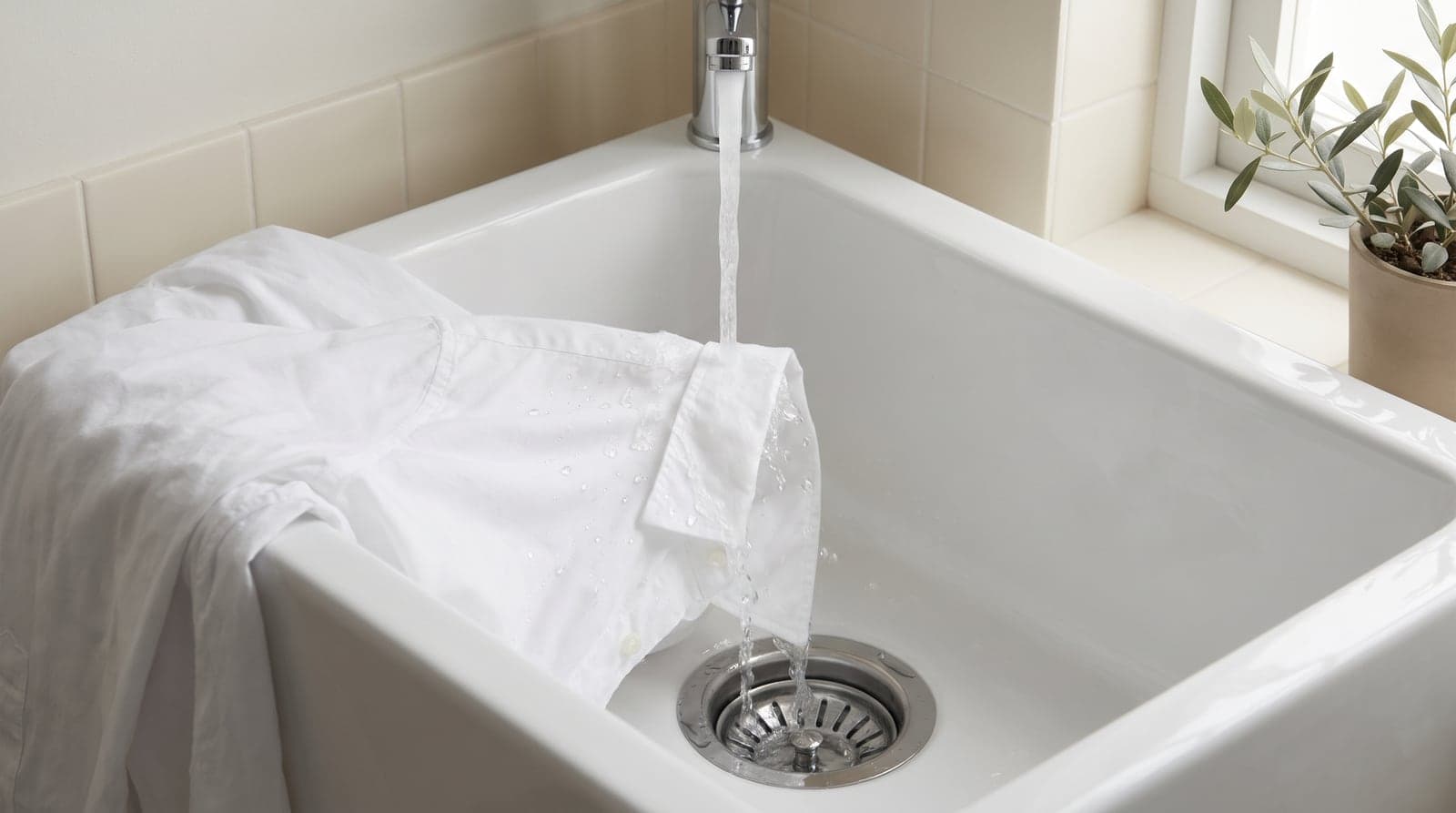
- Brush off any excess and rinse. Tide's first step: "Brush off any excess from the garment before rinsing under cold, running water."
- Blot up what is left; never wipe it or rub it in. Iowa State University Extension's AnswerLine warns that "Wiping the stain can spread it and make a larger stain", and that "Rubbing causes the stain to go deeper into the fabric's yarns and fibers."
- Work liquid laundry detergent or liquid dish soap into the mark and let it sit. This is the one place the fabric is rubbed, gently, to spread the detergent: Tide says to "Use either a soft-bristled toothbrush or rub the fabric together gently to spread the detergent into the fibers of the garment, and let it sit for 5 minutes." Iowa State's version is liquid dish soap or laundry detergent "gently massaged into the stain".
- Wash at the hottest temperature the care label allows. Tide: "Wash on the usual cycle, on the hottest wash temperature indicated", and "Always check the instructions on the garment's care label." The American Cleaning Institute (ACI) and Purdue both say to launder in the hottest water that is safe for the fabric.
- Keep it out of the dryer: air dry, check, and repeat if any remains. Tide: "If the stain persists after washing, repeat the previous steps before tossing in the dryer, as drying will set the stain." ACI: "Do not put it in the dryer until the stain is removed." Iowa State: "Air dry and check to see if the stain is gone. If not, repeat."
From here, how to remove sunscreen stains depends on which mark you have: the greasy method and the rust-colored method are below.
Why does sunscreen leave yellow or orange marks on clothes?
Because avobenzone, a chemical UV filter, reacts with iron in the water the garment is washed in. Tide's care page says the ingredient "can react with iron in hard water", and that the marks "are a result of the chemical reaction that takes place when hard water comes into contact with sunscreens containing avobenzone".
Iowa State's AnswerLine puts it this way: "These ingredients oxidize and tend to produce a yellowish or rust-colored stain when they interact with minerals in water, particularly hard water."
Hard water is the variable. The same product can mark shirts worse in one house than in another, because, as Tide notes, "The severity of these rust stains not only depends on the mineral profile of your water supply, but also on the fiber content of the garment." Tide's own advice follows from that: if you live in a hard water area, check the list of ingredients before buying sunscreen and "avoid those containing avobenzone".
Avobenzone is also the filter people ask about under Hawaii's sunscreen law; whether it is restricted there, statewide or by county, is answered in that post, not here.
How do you remove greasy sunscreen marks?
Treat a greasy sunscreen mark as a grease and oil stain: pretreat with liquid detergent or a prewash stain remover, then launder in the hottest water safe for the fabric. The ACI's stain removal guide, which has no sunscreen entry of its own, gives two grades for grease and oil:
- Light stains. "Pretreat with prewash stain remover, liquid laundry detergent or liquid detergent booster", then "Launder using hottest water safe for fabric."
- Heavy stains, when the light route leaves a mark. ACI's steps use what it calls a "cleaning fluid"; ACI does not name a product, so follow the label of the stain solvent you use. "Place stain facedown on clean paper towels. Apply cleaning fluid to back of stain." Then "Replace paper towels under stain frequently", and finally "Let dry, rinse. Launder using hottest water safe for fabric."
- The dish-soap route. Iowa State says sunscreen oils "are best dealt with using liquid dish soap/laundry detergent products gently massaged into the stain", and then: "After pretreating, rinse and launder using a stain fighting detergent."
- Timing and repeats. ACI's general rules apply: "Deal with it as early as possible", and "If the stain remains, repeat the steps above."
Nothing here involves bleach, and the only soaking is the few minutes the detergent sits on the mark.
How do you remove yellow or rust-colored sunscreen stains?
Treat a yellow or rust-colored sunscreen stain as a rust stain: a rust remover made for fabrics, then a wash, and never chlorine bleach. ACI files rust under "Brown / Yellow Discoloration". Its two steps are "Use a rust remover recommended for fabrics" and "Launder". It adds one warning: "Do not use a sodium hypochlorite bleach to remove rust stains because it may intensify discoloration." Sodium hypochlorite is ordinary chlorine bleach.
Iowa State goes further, and this is the line that settles the soak-or-not question. Because of the ingredients behind a rust-colored mark, it says to "avoid pretreating by soaking garments or using bleach or oxygen bleach products; doing so will have little effect on the stain and may actually make it worse." It names store-bought rust remover products as effective on avobenzone stains, and lists lemon juice and table salt among the household options, without giving a procedure of its own.
Purdue's sequence is simpler: remove any excess, "pretreat the stains with a prewash stain remover", then "Launder, using the hottest water that's safe for the fabric."
Whichever route you take, check before the dryer. If the mark is still there after the wash, repeat the treatment first. Tide says that drying will set the stain, and ACI says not to put it in the dryer until the stain is removed.
What makes sunscreen stains on clothes worse?
Heat, bleach and waiting. The one rule the contradictory advice online misses: letting detergent sit on the mark is for a greasy mark; never soak a rust-colored one. The rest of the list, with who says so:
| What | Why | Who says so |
|---|---|---|
| The dryer | Heat sets a mark that has not come out | ACI: "Do not put it in the dryer until the stain is removed." Tide: "drying will set the stain." |
| Ironing | Same heat, same effect | University of Kentucky Extension: "Ironing might set stains that haven't been completely removed." |
| Chlorine or oxygen bleach on a rust-colored mark | Can intensify the discoloration | ACI: sodium hypochlorite bleach "may intensify discoloration." Iowa State: bleach or oxygen bleach "may actually make it worse." |
| Soaking a garment marked by an avobenzone product | Little effect, and it can make the mark worse | Iowa State, on the avobenzone compounds: "avoid pretreating by soaking garments." |
| Wiping or rubbing | Spreads it, and drives it in | Iowa State: wiping "can spread it and make a larger stain"; rubbing sends it "deeper into the fabric's yarns and fibers." |
| Waiting | The mark ages in, and can surface later | ACI: "Deal with it as early as possible." DLI: age or the heat of cleaning "may cause them to become more apparent." |
| Storing a garment with an invisible mark | A heat-set mark found after storage may be permanent | University of Kentucky: "invisible stains" can cause "permanent discoloration"; heat-set stains found after winter storage "might be impossible to remove." |
The table is our summary of those sources; each quoted phrase is from the page named beside it.
Cotton, synthetics and swimwear
Synthetic fabrics hold a rust-colored mark harder than cotton does, and swimwear needs checking before it goes away for the season. Tide's care page says that "synthetics are more prone to retaining the stain than natural fibers, like cotton".
Swimwear and beach clothes are the garments the storage advice singles out. The University of Kentucky's Extension guide to storing summer clothes says: "Pay close attention to bathing suits or other clothing that might have been in contact with sunscreen or suntan lotion."
Its advice is to treat those items "with a pre-wash stain remover or liquid laundry detergent" before they are washed and stored, because a garment that looks clean "could have 'invisible stains' that might cause permanent discoloration".
Anything that goes to a dry cleaner gets a word at the counter. DLI: "it is important to tell your cleaner if sunscreens or tanning lotions may have contacted the garment."
On beach and pool days the sunscreen and the clothes meet more often, because a water-resistant label asks for reapplication after swimming and towel drying; our guide to what the 80-minute water-resistance rating means sets out that routine.
How do you keep sunscreen off your clothes?
Let it dry before you dress, and keep your hands clean. Five habits, each from one of the sources above:
- Apply it, then let it dry before dressing. Tide: oily stains "are difficult to remove, so you can try to avoid them by applying the sunscreen onto your skin and allowing it to dry before putting clothes on." The American Academy of Dermatology's general direction is "Apply sunscreen to dry skin 15 minutes before going outdoors"; our guide to putting mineral sunscreen on your whole body starts the same way. Neither names a drying time; the 15 minutes is lead time before going outdoors, not a drying clock.
- Wash your hands before you touch the clothes. DLI: "Wash your hands before handling garments to avoid possible staining."
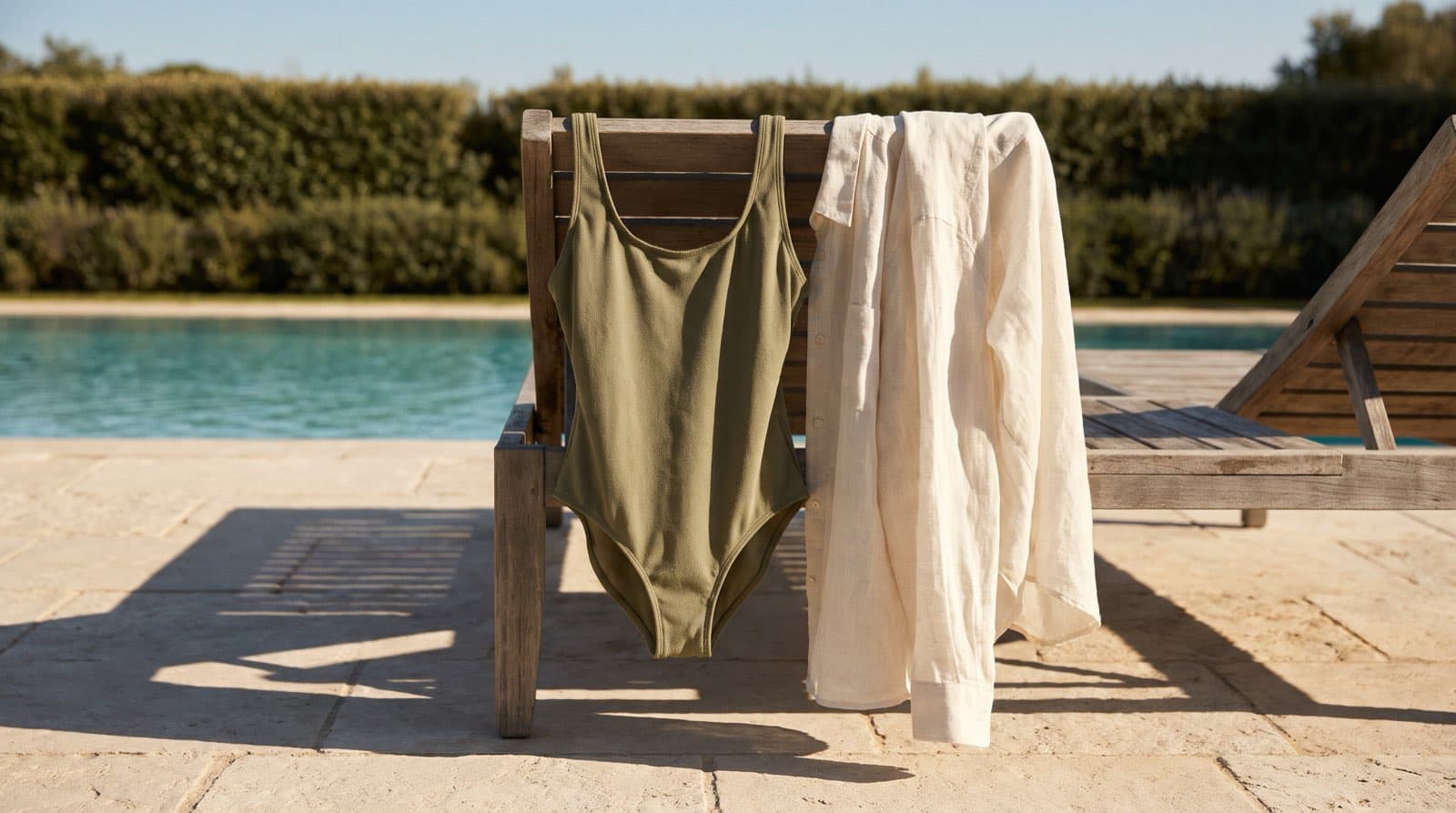
- Dress last. The white shirt or the cover-up goes on after the sunscreen has dried, not before: Tide's timing, applied to the garment you least want marked.
- When you reapply, towel off, reapply, and let it dry again before the shirt goes back on. The schedule is in our guide to how often to reapply sunscreen.
- Expect some to reach the clothes anyway, and say so at the cleaner. DLI notes that even after washing your hands, "some residue may still transfer to clothing through perspiration". Tell your cleaner anyway: DLI's reason is that the oil "may not be easily removed in normal washing or drycleaning procedures".
What's in Solvyn Shield
Solvyn Shield is the mineral sunscreen we make. Its only active ingredient is zinc oxide, at 17.50%. It is dermatologist-formulated, and Dr. Eduardo Weiss, MD, a board-certified dermatologist, leads Solvyn's medical advisory board.
Its label states Broad Spectrum SPF 50 and Water Resistant (80 minutes), the longer of the two water-resistance ratings. Its ingredient list has no avobenzone, oxybenzone, octinoxate, octocrylene or any other chemical-sunscreen active, and no tint or pigment.
Its label's direction is to "Apply liberally 15 minutes before sun exposure and as needed." Rubbed in, it disappears into your skin, with no white cast.
The formula also includes Aloe Barbadensis Leaf Juice, Butyrospermum Parkii (Shea) Butter, and plant oils such as Cocos Nucifera (Coconut) Oil, Carthamus Tinctorius (Safflower) Seed Oil, Persea Gratissima (Avocado) Oil and Adansonia Digitata Oil (baobab).
Every ingredient is on its label on DailyMed, the US National Library of Medicine's drug-label site, where Shield is listed as Solvyn Mineral Sunscreen SPF 50 (NDC 87777-948-00). All 30 inactive ingredients are in the Inactive Ingredients section of its Drug Facts.
If a zinc oxide–only SPF 50 is what you are looking for, Solvyn Shield comes in sealed 5 mL single-use packets, so each use starts with a freshly opened packet and there is no shared bottle or jar.
Primary sources
Laundering authorities
- American Cleaning Institute, Stain Removal Guide — the general rules ("Deal with it as early as possible", "Do not put it in the dryer until the stain is removed", "If the stain remains, repeat the steps above"), the Grease and Oil entry (light and heavy stains) and the "Brown / Yellow Discoloration" entry, its rust-stain entry (rust remover recommended for fabrics; no sodium hypochlorite bleach, which "may intensify discoloration"). The guide has no entry for sunscreen; it is cited here for grease and oil, for rust and for its general rules.
- Tide, "How to Remove Sunscreen Stains" — the five-step method, the care-label and hottest-wash directions, "drying will set the stain", avobenzone and iron in hard water, "a combination stain that contains an oily and a rusty component", synthetics against natural fibers, applying and allowing it to dry before putting clothes on, and the hard-water-area tip. Procter & Gamble's care page for its detergent brand.
- Drycleaning & Laundry Institute, "Stains From Sunscreens And Suntan Lotions" — oils that make the products moisture-resistant, "may not be easily removed in normal washing", invisible stains that become "more apparent" with age or the heat of cleaning, "Wash your hands before handling garments", perspiration, and telling your cleaner.
Cooperative Extension
- Purdue Extension, White County, "Removing Sunscreen Stains" — Denise A. Schroeder, 7 August 2020: "grease stains or an orange, rust-like stain"; remove excess, pretreat with a prewash stain remover, "the hottest water that's safe for the fabric".
- Iowa State University Extension and Outreach, AnswerLine, "Sunscreen Stains" — Marlene Geiger, 18 June 2018, updated March 2025: the oxidation sentence, blotting against wiping and rubbing, dish soap or laundry detergent massaged in, "rinse and launder using a stain fighting detergent", no soaking and no bleach or oxygen bleach, rust removers and household options, "Air dry and check to see if the stain is gone. If not, repeat."
- University of Kentucky Cooperative Extension, "Successfully Storing Summer Clothes" — a Word document (fcs101102): bathing suits and clothing in contact with sunscreen, pre-wash stain remover or liquid laundry detergent before storing, "invisible stains", and ironing that "might set stains that haven't been completely removed".
Applying sunscreen
- American Academy of Dermatology, Sunscreen FAQs — "Apply sunscreen to dry skin 15 minutes before going outdoors." Last updated 11 February 2025.
Label and regulation
- Solvyn Mineral Sunscreen SPF 50, Drug Facts label on DailyMed — zinc oxide 17.50%, the directions ("Apply liberally 15 minutes before sun exposure and as needed") and the inactive ingredient list; on the label image, broad spectrum SPF 50, water resistant (80 minutes) and 5 mL. SPL b0a8d028-87d2-4339-8879-c62cbf8415f2, NDC 87777-948-00. DailyMed, U.S. National Library of Medicine.
- 21 CFR 201.327, on govinfo — the direction every label must carry, to apply "liberally" or "generously" "15 minutes before sun exposure" (paragraph (e)(1)(ii)), and the water resistance statement a label may carry (paragraph (a)(2)).
All quoted text above was read from these records on 27 October 2026.
A note on scope. This article covers getting sunscreen out of clothes and swimwear, as the sources above read on 27 October 2026. It is not medical advice. Stop use and ask a doctor if rash or irritation develops and lasts.
Solvyn makes Shield. Its full label is published on DailyMed and linked above, so you can check every ingredient yourself. You can see Solvyn Shield's packets and prices.