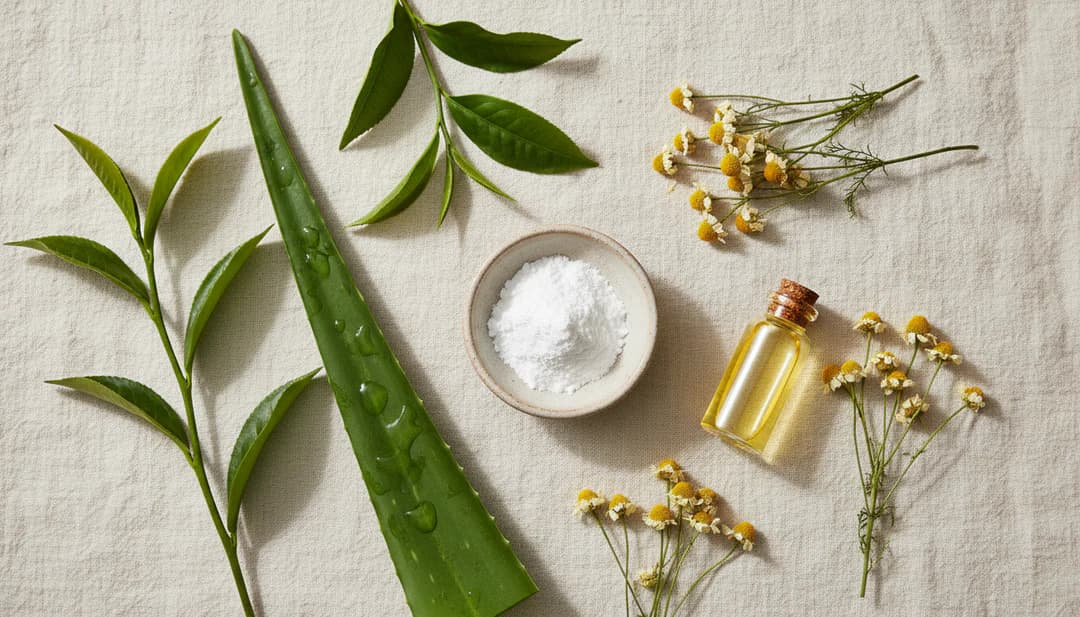

A mineral sunscreen for your body is one whose Active Ingredients box lists only zinc oxide, titanium dioxide or both, and the American Academy of Dermatology advises one labeled broad spectrum, SPF 30 or higher and water resistant. Apply it liberally to all the skin your clothes leave bare, and unless its label says otherwise, a body lotion or cream can go on your face too; there, the Academy says, use at least a teaspoon.
The Academy also notes that many people apply only 20 to 50 percent of the amount needed to reach the SPF on the label. So the amount, not the choice of bottle, is often where body protection falls short.
This guide sets out what the Academy, the US Food and Drug Administration (FDA) and the federal sunscreen rule (21 CFR 201.327) say about choosing and applying a mineral body sunscreen. All were read on 5 October 2026. The guide does not rank products, and it leaves the mineral-versus-chemical question aside.
Can you use mineral sunscreen on your body?
Yes. Whether a sunscreen is chemical, mineral or a mix, the American Academy of Dermatology says any of them "can effectively protect you from the sun if you select one that is broad spectrum, water resistant, and has an SPF 30 or higher." Its advice is to wear sunscreen on all skin not covered by clothing.
The Academy's name for a mineral sunscreen is a physical sunscreen: one whose active ingredient is "titanium dioxide, zinc oxide, or both." A sunscreen that combines those with active ingredients found in chemical sunscreens is what it calls a hybrid.
So what makes a body sunscreen mineral is its Active Ingredients box, not the word "body" or "face" on the front. And whatever the active ingredient, the federal sunscreen rule requires every label it covers to warn "Do not use on damaged or broken skin."
What should a mineral body sunscreen's label say?
No single bottle is right for every body; six things on the label tell you whether one does the job.
- Active Ingredients: only zinc oxide, titanium dioxide or both. The Academy's tip: look at "the section on the container labeled 'Active Ingredients.'"
- "Broad Spectrum": protection against both UVA and UVB rays, as the Academy defines it. Under the federal rule it is a tested claim: a product may print it only after passing the rule's broad spectrum test.
- SPF 30 or higher, the Academy's advice. SPF indicates the level of sunburn protection, the FDA says; SPF 30 "blocks 97% of the sun's UVB rays," says the Academy, and "no sunscreen can block 100%."
- "Water Resistant (40 minutes)" or "(80 minutes)": the only two water-resistance statements the rule provides for. The rule calls "sunblock," "sweatproof" and "waterproof" false or misleading on a sunscreen, and the FDA puts it plainly: "There's no such thing as 'waterproof' sunscreen."
- A form for large areas. The Academy suggests gels for "hairy areas, such as the scalp or male chest" and creams for dry skin; a spray should be rubbed in once the skin glistens.
- A size that matches the skin you cover and how often you reapply: see how far one bottle goes.
How much sunscreen does your body need?
Enough to cover all the skin your clothes leave bare, applied liberally.
"Liberally" is the label's own word: every label the federal rule covers says to apply it "liberally" or "generously" 15 minutes before sun exposure. The Academy's advice is to "apply sunscreen to all skin not covered by clothing."
Why liberally? The SPF on a label is measured at "2 milligrams per square centimeter" of skin under the federal rule; the number on the label describes skin covered at that rate, not a lighter coat.
Can you use body sunscreen on your face?
Yes, unless its label says not to, and as long as it is not a spray aimed at your face. The FDA's general directions are to use enough to "cover your entire face and body (avoiding the eyes and mouth)."
- Amount: at least a teaspoon for the face alone, by the Academy's measure: about enough to cover the length of your index and middle fingers.
- Form: "Creams are best for dry skin and applying on the face," "Gels are good for oily complexions," and "Sticks are good to use around the eyes," the Academy says.
- Sprays: never "applied directly to your face," says the FDA, and the Academy says never to spray near the face or mouth, so you don't inhale it.
- Eyes and rash: every label the federal rule covers says to keep it out of the eyes and rinse with water, and carries a "Stop use and ask a doctor" warning about a rash; follow the exact wording on the label you hold.
- Fragrance: if you would rather keep fragrance off your face, the inactive list is where to look. Here is how to check any label for fragrance.
What is the difference between face sunscreen and body sunscreen?
The difference is mostly the amount, the form and the rest of the formula, not the tests behind the label. The federal sunscreen rule sets one SPF test and one broad spectrum test for the sunscreens it covers, and a core set of warnings and directions "for all sunscreen products."
| What | Face vs body | Source |
|---|---|---|
| The SPF number | Same test | The federal rule |
| "Broad Spectrum" | Same test | The federal rule |
| Water resistance | Same two statements: 40 or 80 minutes | The federal rule |
| Warnings and directions | Same core requirements, including the 15-minute and under-6-months directions | The federal rule |
| The amount you need | Can differ: at least a teaspoon for the face alone, more for the rest of your bare skin | The Academy |
| The form | Can differ: lotion, cream, gel, stick or spray | The Academy |
| The inactive ingredients | Can differ | Each product's own list |
| The container size | Can differ: compare price per fluid ounce | Each product's label |
The Academy's view is that the kind of sunscreen you use "is a matter of personal choice and may vary depending on the area of the body to be protected."
Can face sunscreen go on your arms? Yes: read its label the same way, and check its fluid ounces first, since the rest of your bare skin takes more than your face.
How to put mineral sunscreen on your whole body
Face first, then the rest of your bare skin, then the spots people miss.
- Start on dry skin, 15 minutes before you go outdoors, as the Academy advises. Every label the federal rule covers says to apply it "15 minutes before sun exposure"; the FDA's reason: "This allows the sunscreen to have enough time to provide the maximum benefit."
- Then the face, neck and ears. The Academy's "at least 1 teaspoon" is for the face alone, so give your face a full teaspoon and your neck and ears more on top.
- Apply it liberally, as the label directs, and spread it evenly over the rest of the skin your clothes leave bare.
- Then check the spots people miss.
Which spots do people miss?
Ears, the back of the neck, hands, the tops of the feet, the hairline and any exposed scalp: the FDA lists them, with the nose and lips, as "frequently forgotten spots." The Academy names several of the same.
| Spot | FDA's "frequently forgotten spots" | American Academy of Dermatology |
|---|---|---|
| Ears | Listed | Listed |
| Nose | Listed | Part of the face, which it lists |
| Lips | Listed: "use SPF lip balm" | A "lip balm with an SPF of at least 30" |
| Back of the neck | Listed | Listed, as the neck |
| Hands | Listed | Not named |
| Tops of the feet | Listed | Listed |
| Along the hairline | Listed | Not named |
| Exposed scalp | Listed, "from balding or thinning hair" | Sunscreen on the scalp, or "wear a wide-brimmed hat" |
| Back | Not named | For hard-to-reach areas, "ask someone to help you or use a spray sunscreen" |
| Legs | Not named | Listed |
"Not named" means that list or page does not mention the spot; it is not advice to skip it.
How far does one bottle go?
That depends on how much skin you cover and how often you reapply, and the label tells you how often.
On a water-resistant label the reapply line reads: reapply after 40 or 80 minutes "of swimming or sweating," "immediately after towel drying," and "at least every 2 hours."
A higher SPF does not stretch that: "high-number SPFs last the same amount of time as low-number SPFs," the Academy says.
When you compare bottles, compare price per fluid ounce, not per bottle.
Keep it out of the heat: every label the rule covers says to "protect the product in this container from excessive heat and direct sun," and the FDA suggests "wrapping the containers in towels or keeping them in the shade."
Flying? A separate guide covers what sunscreen fits in a carry-on.
Clothing and shade do part of the job
What you wear shrinks the area you have to cover. Every patch your clothes leave bare still needs sunscreen, and sunscreen does not do the whole job either: the Academy says "sunscreen alone cannot fully protect you."
- Shade: the sun's rays are strongest between 10 a.m. and 2 p.m., the Academy says, and "If your shadow is shorter than you are, seek shade."
- On the label: sunscreens rated Broad Spectrum SPF 15 or higher carry "Sun Protection Measures" in their directions, including "limit time in the sun, especially from 10 a.m.-2 p.m." and "wear long-sleeved shirts, pants, hats, and sunglasses."
- Clothing: the Academy suggests clothing with a UPF (ultraviolet protection factor) number on the label.
- Water, snow and sand: take extra care near them, the Academy says, as they can increase your chance of sunburn; and "Even on cloudy days, up to 80% of the sun's harmful UV rays can penetrate the clouds."
- Babies under 6 months: every label the rule covers says "children under 6 months of age: Ask a doctor," and the FDA says "Sunscreen is not recommended for infants under six months old"; it advises keeping them out of the sun from 10 a.m. to 2 p.m., in protective clothing if they have to be in it.
Where a 5 mL packet fits
We make Solvyn Shield, labeled as Solvyn Mineral Sunscreen SPF 50 (National Drug Code 87777-948-00).
Zinc oxide 17.50% is its only active ingredient. It is labeled Broad Spectrum SPF 50 and Water Resistant (80 minutes). It is a cream, in packets of 5 mL (0.17 fl oz) each.
Solvyn Shield's sealed single-use 5 mL packets are also called sachets.
At 5 mL, each packet is well under the Transportation Security Administration's 3.4-ounce (100 mL) limit for each container in a carry-on.
Its 30 inactive ingredients include Carthamus Tinctorius (Safflower) Seed Oil, Cocos Nucifera (Coconut) Oil, Persea Gratissima (Avocado) Oil, Adansonia Digitata Oil, Butyrospermum Parkii (Shea) Butter and Tridecyl Salicylate, among others; all 30 are listed on our ingredient and application page.
Among its label's directions: "apply liberally 15 minutes before sun exposure"; reapply "after 80 minutes of swimming or sweating," "immediately after towel drying" and "at least every 2 hours"; and "Children under 6 months of age: ask a doctor."
Among its warnings: "Do not use on damaged or broken skin." It also says to "protect the product in this container from excessive heat and direct sun." The full Drug Facts are on DailyMed, linked under Primary sources.
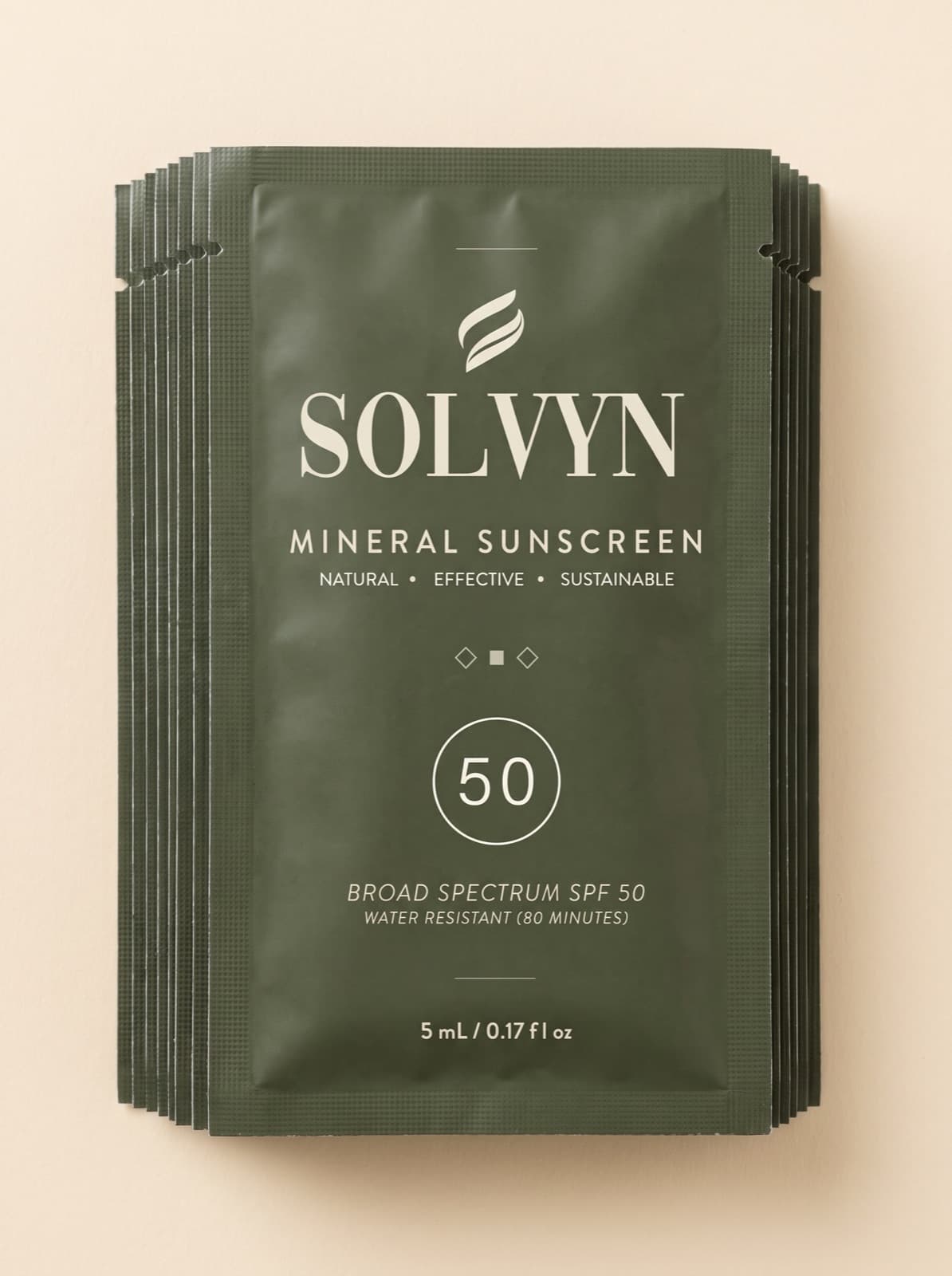
Our sunscreen
Solvyn Shield
Broad spectrum SPF 50 mineral sunscreen, water resistant (80 minutes). Zinc oxide 17.50% is the only active ingredient, in sealed 5 mL packets.
Primary sources
American Academy of Dermatology
- How to apply sunscreen, last updated 15 August 2025: sunscreen on all skin not covered by clothing; at least 1 teaspoon for the face, about the amount needed to cover the length of the index and middle fingers; the neck, face, ears, tops of the feet, legs, scalp and lips; a helper or a spray for the back.
- Sunscreen FAQs, last updated 11 February 2025: physical and hybrid sunscreens and the Active Ingredients section; any type "can effectively protect you"; SPF 30 and 97% of UVB; high-number SPFs last the same time; many people apply 20 to 50 percent of the amount needed; dry skin, 15 minutes before going outdoors; the forms, the spray technique and spraying away from the face; seeking shade; UPF clothing; water, snow and sand; cloudy days; "sunscreen alone cannot fully protect you."
- How to select sunscreen: broad spectrum, which it defines as protection from both UVA and UVB rays; SPF 30 or higher; water resistant.
U.S. Food and Drug Administration
- Sunscreen: How to Help Protect Your Skin from the Sun, content current as of 10 September 2026: apply 15 minutes before sun exposure and why; the entire face and body, avoiding the eyes and mouth; the frequently forgotten spots; what SPF indicates; sprays never applied directly to the face; no "waterproof" sunscreen; storage in towels or shade; infants under six months.
Federal rule
- 21 CFR 201.327, Over-the-counter sunscreen drug products; required labeling based on effectiveness testing, eCFR, up to date as of 1 October 2026 (source note: 76 FR 35660, 17 June 2011, as amended at 76 FR 38975, 5 July 2011; eCFR's version history records no amendment since 29 November 2016). Cited: the Broad Spectrum SPF statement only for products that pass the broad spectrum test, (a)(1); the water resistance statements, (a)(2); the warnings for all sunscreen products, (d)(1); the directions for all sunscreen products, including "liberally" or "generously" 15 minutes before sun exposure, (e)(1), and the Sun Protection Measures, (e)(2); the reapply direction for water resistant products, (e)(3); the storage statement, (f); false and misleading claims, (g); the SPF test and its 2 mg/cm² application, (i); the broad spectrum test, (j).
Air travel
- Liquids, Aerosols, and Gels Rule, Transportation Security Administration: carry-on liquids and creams in "travel-sized containers that are 3.4 ounces (100 milliliters) or less per item," in a quart-sized bag.
The product label
- Solvyn Mineral Sunscreen SPF 50, Drug Facts label on DailyMed: zinc oxide 17.50% as the active ingredient, the 30 inactive ingredients in its Drug Facts, the warnings, the directions and the storage line; the dosage form its listing gives, cream ("zinc oxide cream"), and its package type, packet; and, on the label image, Broad Spectrum SPF 50, Water Resistant (80 minutes) and 5 mL / 0.17 fl oz. NDC 87777-948-00, label information updated 15 June 2026. DailyMed, U.S. National Library of Medicine.
All figures and quoted text above were read from these records on 5 October 2026.
A note on scope. This guide covers US rules and guidance, as read on 5 October 2026. It is general information, not medical advice. Follow your sunscreen's label, and ask a doctor about babies under 6 months or about a skin condition.
Solvyn makes a mineral sunscreen in single-use packets, so we have an interest in this question. Every figure above comes from the sources listed. If a sealed, single-use sunscreen is what you need, you can see Solvyn Shield's packets and prices.