Sunscreen labels carry a lot of words that sound like standards. Some of them are. "SPF 50" and "broad spectrum" are both defined in federal regulation, tested against a published method, and mean a specific thing. "Fragrance-free" is not one of those words. No United States regulation defines it, and no agency tests for it.
What is regulated is the ingredient list underneath. Federal rules require every ingredient to be named, in order — and then carve out one exception, by name, for fragrance. That exception is the whole problem: a single word may stand for a mixture of dozens of undisclosed components, and it is entirely lawful.
This article sets out what the regulation actually says, quoted from the record, and what that leaves a reader to do instead. Where the federal position is guidance rather than law, that is said plainly.
What does "fragrance-free" mean on a sunscreen label?
By regulation, nothing. There is no federal definition of the term, no test behind it and no agency that certifies it. A manufacturer decides whether to print it.
That does not make it meaningless — most companies using it mean they added no fragrance — but it does mean the phrase is a statement of intent rather than a specification. It is not comparable to "SPF 50", which is a number produced by a defined test.
The Food and Drug Administration's own guidance is instructive here, because of what it advises rather than what it defines:
This is the FDA’s consumer-facing guidance page, not a regulation. It states the agency’s position and its advice; it does not itself impose a requirement, and although it uses the phrase in its advice, it does not define it anywhere on the page.
FDA does not have the same legal authority to require allergen labeling for cosmetics as for food. So, if you are concerned about fragrance sensitivities, you may want to choose products that are fragrance free, and check the ingredient list carefully.
U.S. Food and Drug Administration · read word for word on FDA advises two things here, not one: choose fragrance-free products, and check the ingredient list. The phrase is a starting point the agency itself pairs with reading the list.
Is "fragrance-free" the same as "unscented"?
No, and the difference is the one most likely to trip someone up. "Unscented" describes how a product smells. It does not describe what is in it.
This is the FDA’s consumer-facing guidance page, not a regulation. It states the agency’s position and its advice; it does not itself impose a requirement, and although it uses the phrase in its advice, it does not define it anywhere on the page.
Even some products labeled “unscented” may contain fragrance ingredients. This is because the manufacturer may add just enough fragrance to mask the unpleasant smell of other ingredients, without giving the product a noticeable scent.
U.S. Food and Drug Administration · read word for word on FDA says this of “unscented” specifically. It is advice about how a product smells, not a rule about what is in it.
A masking fragrance is still a fragrance ingredient. A product can be genuinely unscented — you smell nothing — and still contain the exact class of ingredient someone avoiding fragrance is trying to avoid. The two words are not synonyms, and only one of them is about composition.
Why doesn't the label say what the fragrance is?
One step first, because a sunscreen is not a cosmetic in the regulatory sense — it is an over-the-counter drug that is also a cosmetic. §701.3(d) sends that combination to the Drug Facts rule at §201.66, and §201.66(c)(8) sends the inactive ingredients straight back to §701.3(a) or (f). So the cosmetic rule below is the rule governing the inactive list on the back of a sunscreen, by that route.
Because the regulation permits it not to. The rule governing cosmetic ingredient declaration sets out the general requirement and then names its own exception in the same sentence:
The label on each package of a cosmetic shall bear a declaration of the name of each ingredient in descending order of predominance, except that fragrance or flavor may be listed as fragrance or flavor.
U.S. Government Publishing Office · read word for word on Read the shape of it: every ingredient, in order of how much is in the product — except one category, which may be collapsed into a single word.
There is a limit, but it is narrower than it first sounds. It restricts what may be called fragrance, not how much detail must be given about it:
No ingredient may be designated as fragrance or flavor unless it is within the meaning of such term as commonly understood by consumers.
U.S. Government Publishing Office · read word for word on
Two different things are going on in the same paragraph, and they are worth separating. The fragrance exception is unconditional: a company may write "fragrance" without asking anyone. Separately, where FDA has accepted an ingredient as exempt from public disclosure under §720.8(a), the phrase "and other ingredients" may be used at the end of the list in place of naming it:
Where one or more ingredients is accepted by the Food and Drug Administration as exempt from public disclosure pursuant to the procedure established in § 720.8(a) of this chapter, in lieu of label declaration of identity the phrase “and other ingredients” may be used at the end of the ingredient declaration.
U.S. Government Publishing Office · read word for word on This is the trade-secret route, and it is the more consequential of the two: it lets a list be lawfully incomplete. It also has a tell — a list that ends in that phrase is telling you something is missing.
Two caveats on "in descending order". Paragraph (f) lets anything present at one percent or less be listed in any order, so position tells you less than it looks like it does toward the end of a list. Paragraph (l) exempts incidental ingredients present at insignificant levels with no technical or functional effect.
How do you actually check whether a sunscreen has fragrance in it?
Read the ingredient list and look for three things.
The word itself. "Fragrance", or "Parfum" on a product also sold in Europe. If either appears, there is a fragrance mixture in the formula and the label will not tell you what is in it.
Named aroma chemicals. Some products name components individually instead of, or as well as, using the umbrella term. Limonene, linalool, citronellol, geraniol, citral, coumarin and eugenol are the ones that appear most often.
Essential oils. These are the ones people miss, and they are covered in the next section.
If none of the three is present, the phrase on the front of the pack is supported by everything the label is required to show you — which is most of a formula, not provably all of it.
And if a brand does not publish its list, you can still get it. Every sunscreen sold in the United States is registered with FDA, and its full label — actives, inactives and all — is published at dailymed.nlm.nih.gov. Search the product name. That copy is the government's, not the manufacturer's, which makes it the one worth reading when the two could differ.
Do essential oils count as fragrance?
For someone reacting to fragrance, usually yes — and this is where "natural" labeling causes the most confusion.
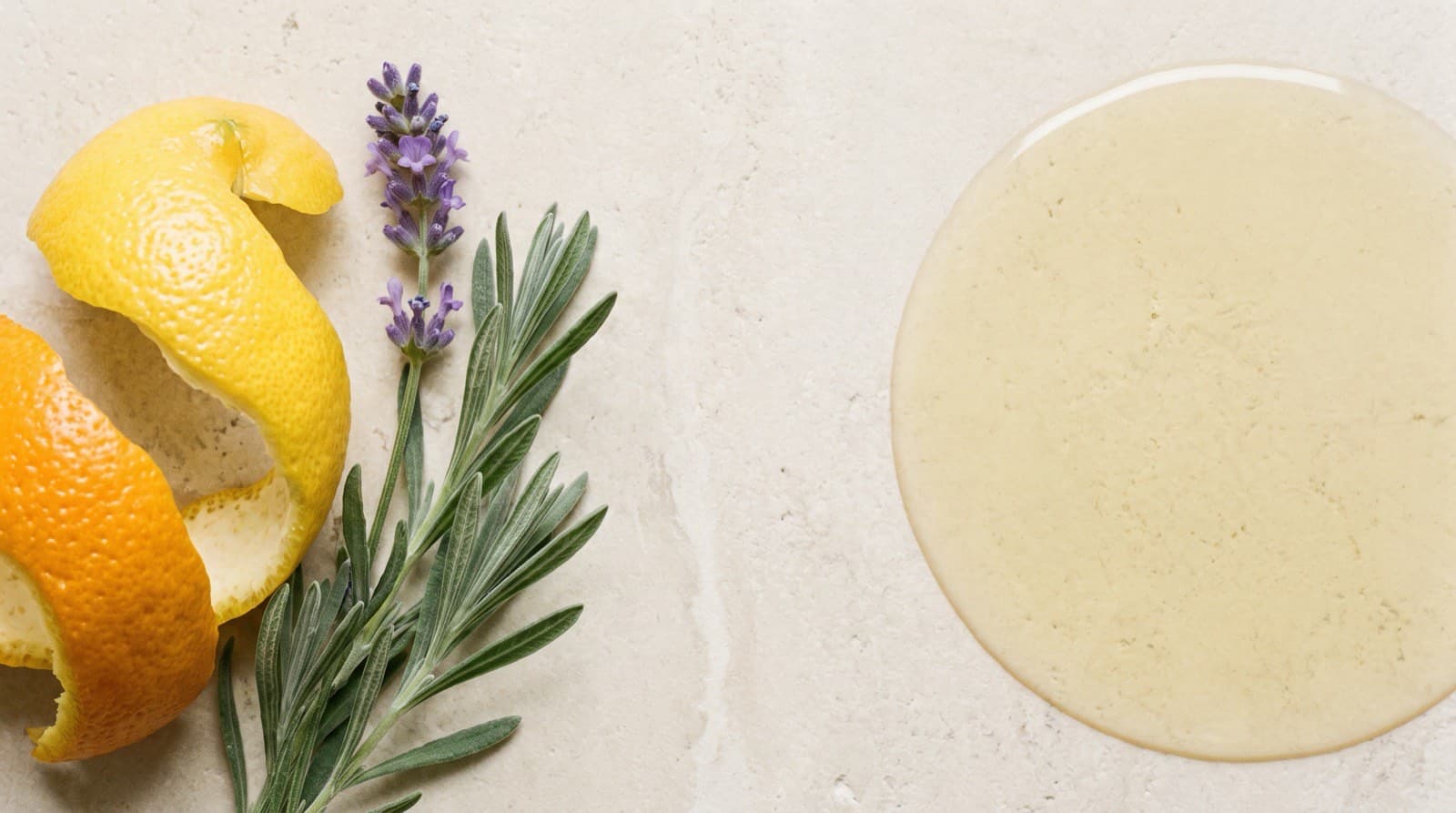
An essential oil is a concentrated aromatic extract. Lavender, citrus peel, ylang-ylang and peppermint oils are the common ones in skincare, and they carry the same aroma chemicals that appear on allergen lists. A product can carry no "fragrance" in its ingredient list, be marketed as naturally scented, and still be a poor choice for someone avoiding fragrance.
Carrier oils are a different thing and are worth separating. Safflower, coconut, avocado, shea and baobab are fixed oils used to carry and soften a formula. They are not aromatic extracts and they are not what the allergen lists are about. "Contains plant oils" and "contains essential oils" are not the same statement.
Why this matters more on sunscreen than on most products
Sunscreen is applied in a wider layer than almost anything else in a routine, to the face and body at once, and reapplied through the day. Whatever is in it is in prolonged contact with a lot of skin.
It is also applied in heat, often with sweat and water involved. None of that makes fragrance harmful to most people. It does mean that if someone has decided to avoid it, sunscreen is a product where the decision is worth carrying through properly.

What this looks like in a mineral sunscreen
Mineral formulas differ from chemical ones in what does the filtering, not in what else is in the jar. A single mineral filter removes the need to stabilize a blend of organic ones, but the emollients, emulsifiers, humectants and antioxidants are unchanged by that choice — Shield's own inactive list runs to thirty entries.
Plenty of mineral sunscreens contain fragrance, and plenty of chemical ones do not. The filter type tells you what blocks the UV. It does not tell you what else is in the formula — the list does.
What Solvyn Shield's ingredient list says
Solvyn makes a mineral sunscreen, so run the same three checks on ours. The list is published in full so that it can be checked rather than taken on trust — and that is the test this article has been describing, applied to us: the list exists, it is public, and it is on file with a federal agency, so nothing here rests on our word for it.
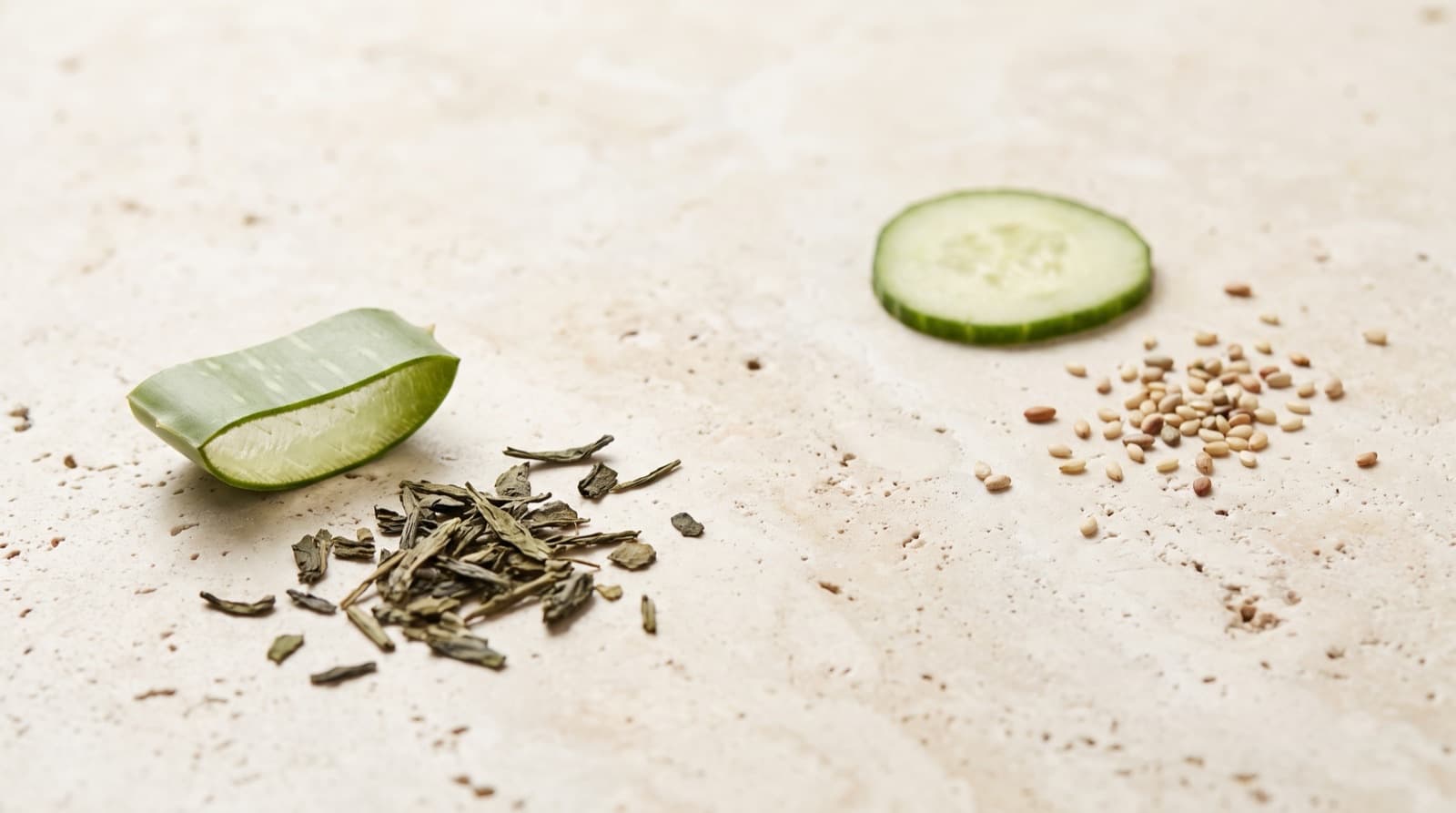
Solvyn Shield — registered with FDA as Solvyn Mineral Sunscreen SPF 50, NDC 87777-948-00 — has one active filter: zinc oxide at 17.50%. Thirty inactive ingredients follow it: water, emollient esters, emulsifiers, humectants, antioxidants, fixed plant oils and butters — safflower, coconut, avocado, shea, baobab — and six botanical extracts: aloe, cucumber, carrot seed, green tea, pomegranate and blueberry.
Against the three tests above. There is no "fragrance" and no "parfum" in the list. None of the individually-named aroma chemicals appears in it. And on the third test — the one people miss — there is no essential oil in it: the plant oils are fixed oils, and the one entry a reader checking properly would stop on is carrot seed, which the registered label declares as Daucus Carota Sativa (Carrot) Seed Extract, not as the aromatic seed oil. We would rather name it than leave it inside the word "including".
We also print "fragrance-free" on our shop page, and by the argument above that is a statement of intent rather than a specification. So it is worth being exact about what we mean by it: no fragrance mixture, no parfum, no masking fragrance and no essential oils were added to the formula. The ingredient list is what makes that checkable, which is why it is published in full.
Do not take that from us. Our own copy — the INCI panel as printed on the sachet, checked against the registered label on 6 September 2026 — is on the ingredient and application page. The government's copy is the registered label at DailyMed. Read either against any other sunscreen you are considering, which is the only comparison that settles anything.
If that is the list you were looking for, Shield is sold in boxes of sealed single-use sachets.
How to verify any of this yourself
Every claim above about what the regulations require and what FDA advises traces to public documents: two sections of federal regulation and one FDA guidance page. The statements about our own product trace to one more, also public: the label registered with FDA. Where the article generalizes about how products are formulated, that is our observation and is written as one.
- The regulations are 21 CFR §701.3 and, for a sunscreen, §201.66(c)(8), which routes the inactive list back to it. Both are published by the U.S. Government Publishing Office. §701.3 is short. Its first sentence carries both the general rule and the fragrance exception; the paragraph runs to four, and the fourth is the trade-secret route.
- The agency position is FDA's Fragrances in Cosmetics page, which is guidance rather than law — it states what the agency thinks and advises, not what it requires.
- The product record is Shield's own label as filed with FDA and published by the National Library of Medicine. Most US sunscreens have one. Search the product at dailymed.nlm.nih.gov and read the inactive ingredients off the government's copy rather than the manufacturer's — including ours.
One practical note on reading the regulation: the authoritative current text lives on eCFR, which redirects automated requests to an interstitial page. The passages quoted here were read from the Government Publishing Office's annual edition instead, which is the same publisher's compilation and can actually be retrieved. If you are checking a detail that turns on a recent amendment, open eCFR in a browser rather than relying on the annual edition or on us.
Primary sources
Federal regulation
- 21 CFR §701.3 — Designation of ingredients — the cosmetic ingredient declaration rule, including the fragrance and flavor exception in paragraph (a). U.S. Government Publishing Office, 2023 annual edition.
- 21 CFR §201.66 — Format and content requirements for over-the-counter drug product labeling — the Drug Facts rule. Paragraph (c)(8) sends the inactive ingredients of an OTC drug that is also a cosmetic, such as a sunscreen, to §701.3(a) or (f). U.S. Government Publishing Office, 2023 annual edition.
Agency guidance
- Fragrances in Cosmetics — FDA's consumer-facing page on fragrance labeling, masking fragrance in "unscented" products, and the trade-secret basis for the single-word declaration.
The product label
- Solvyn Mineral Sunscreen SPF 50 — registered label — the Drug Facts label and the full inactive ingredient list as registered with FDA. NDC 87777-948-00, labeller Solvyn Skin LLC, label information updated 15 June 2026. DailyMed, U.S. National Library of Medicine.
All quoted text above was read from these records on 22 September 2026.
A note on scope. This article is about United States cosmetic labeling and reflects sources read on 22 September 2026. Other markets require more: the European Union, for example, requires a number of specific aroma chemicals to be named individually rather than folded into "parfum", so the same formula can produce a longer ingredient list there. Nothing here is medical advice. If you have a diagnosed fragrance allergy or a reacting skin condition, a clinician and a patch test will tell you more than any label will.
Solvyn makes a mineral sunscreen, which means we have an interest in how this subject is framed. We have tried to keep that out of the analysis: the regulation is quoted rather than summarized, the FDA page is labeled as guidance rather than law, and our own ingredient list is linked so it can be checked instead of believed. If you are choosing sun care for a hotel, resort or venue, you can explore Solvyn for business.